
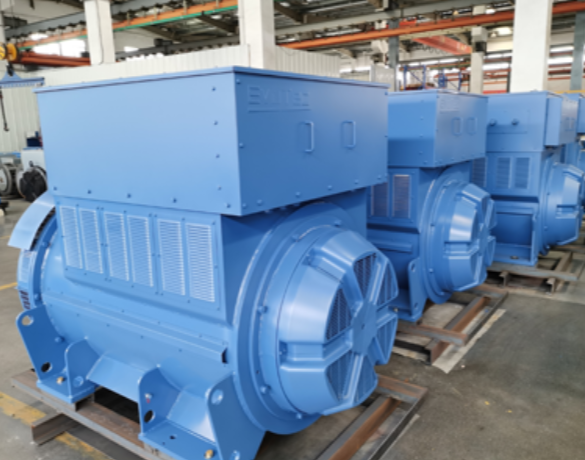
The shift toward hybrid microgrids and renewable-backed systems demands a new way of thinking about capacity — not as a single big 3 mw generator sizing problem but as a layered resilience strategy that blends central plant muscle with distributed units. This comparative argument starts with the alternator as a pivot: a high performance alternator can make a 3 MW set efficient, but it doesn’t answer questions about operational flexibility, ramp response, or islanding. My case proceeds from cost and control to a practical buying frame for engineers and facility managers who must balance peak capacity with rapid response and maintainability.
Comparative Insight: Big 3 MW Sets vs. Networks of 30 kVA Units
A single 3 mw generator still wins on continuous heavy-load delivery and economies of scale in fuel consumption. It also simplifies synchronization and governor control when serving a centralized plant. But distributed 30 kVA units change the calculus: they provide granular fault tolerance, faster startup, and easier staged maintenance. A cluster of modular units reduces single-point failures and lets operators match supply to variable renewable output using inverters and automatic transfer switch (ATS) logic. For many facilities, the right answer is hybrid: keep a primary 3 mw asset for sustained base load while using multiple 30 kva generator units to handle transient peaks and critical circuits.
Operational Trade-offs and Real Costs
When arguing in favor of one architecture over another, focus on three measurable operating variables: ramp time, maintenance downtime, and fuel efficiency under part load. A 3 MW set often runs inefficiently at 30–50% load; multiple 30 kVA units can be staged to run nearer to optimal load points, improving specific fuel consumption. Add a load bank during commissioning to verify performance curves. Also consider maintenance cadence: modular units shorten mean time to repair because you swap one unit rather than take the whole plant offline. The alternator and prime mover spec sheet matter — insulation class, bearing arrangement, and excitation system affect lifecycle costs.
Common Mistakes in Transitioning to Hybrid Microgrids
Operators routinely overemphasize headline capacity and neglect control architecture. They buy a 3 mw generator for perceived safety but fail to integrate synchronization and inverter control properly — a costly oversight. Another error is underinvesting in automation: a well-configured ATS, governor tuning, and remote monitoring are what turn capacity into usable resilience. Finally, procurement teams sometimes ignore load sequencing; small critical loads should sit on independent 30 kVA units or dedicated transfer schemes to avoid cascading outages.
Real-World Anchor and EEAT Mode
EEAT mode: expert-anchored analysis grounded in operational history. Consider Puerto Rico after Hurricane Maria: prolonged outages showed how a single central plant can leave regions vulnerable while modular gensets restored essential services faster. That event pushed hospitals and telecom sites toward mixed deployments with distributed alternators and inverter systems — a practical precedent for today’s policy and procurement debates. Use that case as a lens: measure restoration time, spare-part logistics, and local fuel access before deciding capacity strategy.
Selection Framework: What to Prioritize
Design this checklist into procurement documents. Focus on: – Response profile — seconds to synchronize, black-start capability, and governor droop settings. – Modularity — ease of swapping and commonality of parts across 30 kVA units. – Controls — native support for inverter integration, remote telemetry, and synchronization logic. These metrics reduce political risk around energy security and show decision-makers that resilience is quantifiable, not just an expense line.
Advisory: Three Critical Evaluation Metrics
1) Effective Load Coverage Ratio (ELCR): the percentage of critical load that can run on staged 30 kVA units without touching the 3 mw set. Measure this in hours and during peak renewable curtailment. 2) Time-to-Restore (TTR): seconds or minutes to bring critical circuits online after grid loss, validated with a live transfer test. 3) Lifecycle Cost per kWh at Typical Dispatch: include scheduled maintenance, expected fuel mix, and the alternator’s rated efficiency curve to compare real operating expense — not just capital spend.
Adopt these metrics and you move the argument from abstract resilience to board-room defensibility. —